The installation of a PSA Oxygen Plant at DHQ Parachinar to establish a reliable, on-site oxygen generation system within the district. The plant will produce medical-grade oxygen (90–95% purity) with a capacity of 5 Nm³ per hour, enabling the hospital to meet its oxygen requirements independently. The system will include an air compressor, filtration unit, storage tank, cylinder filling manifold, automated control panel, and a dedicated backup generator to ensure continuous 24/7 operation, even during power outages or periods of isolation.
Located along Pakistan’s mountainous border, District Kurram and its hub Parachinar face persistent challenges due to geographical isolation, limited infrastructure, and recurring security-related disruptions. Frequent road blockages cut off the region from major cities, restricting the supply of essential items such as medicines and medical oxygen.
The population largely depends on daily wage labor and small-scale livelihoods, making it difficult for families to access timely healthcare or travel outside the district during emergencies. Healthcare facilities remain under-resourced and heavily dependent on external supply chains.
In such conditions, the most critical gap is the lack of reliable oxygen availability. Hospitals rely on oxygen cylinders transported from other cities, and when roads are closed, this supply is disrupted. This creates life-threatening delays for critically ill patients, including newborns, emergency trauma cases, and those with respiratory conditions.
Key Outcomes
Supports approximately 15–20 patients simultaneously
Benefits around 1,000 patients per month
Ensures continuous oxygen availability for critical and emergency care
Reduces reliance on externally transported oxygen
Strengthens hospital preparedness during road closures and crises
The Free Eye Camp project was a targeted medical intervention implemented by WF-AID at District Headquarters Hospital (DHQ), Parachinar, and Al-Zahra Hospital, Hangu, between 21 December 2025 and 11 January 2026, building on the successful completion of earlier cataract surgery interventions in Parachinar.
The strong response to previous camps highlighted a continued need for accessible eye care, leading to the expansion of services during this phase.
Thanks to the generous support of the Mohsin & Fauzia Jaffer Foundation (MFJ), this initiative reached a total of 1,309 patients. Out of these, 350 patients underwent free cataract surgery using modern phaco techniques, including 325 surgeries in Parachinar and 25 in Hangu, while 830 patients received essential medicines following OPD eye consultations.
Services were delivered by an experienced eight-member medical team. The project contributed to improved vision and better daily functioning for vulnerable individuals, particularly the elderly, widows, and low-income earners.
Thanks to the generous support of the Mohsin & Fauzia Jaffer Foundation (MFJ), this initiative successfully provided 200 free cataract surgeries and 830 free eye consultations to underprivileged patients. A team of eight medical professionals, led by Dr. Tanveer Abbas, performed the surgeries using modern Phaco techniques. This initiative marked the first instance of advanced Phaco surgeries being performed in Parachinar, successfully restoring sight and independence to hundreds of individuals. In total, 830 people benefited, many of whom were widows and low-income laborers.
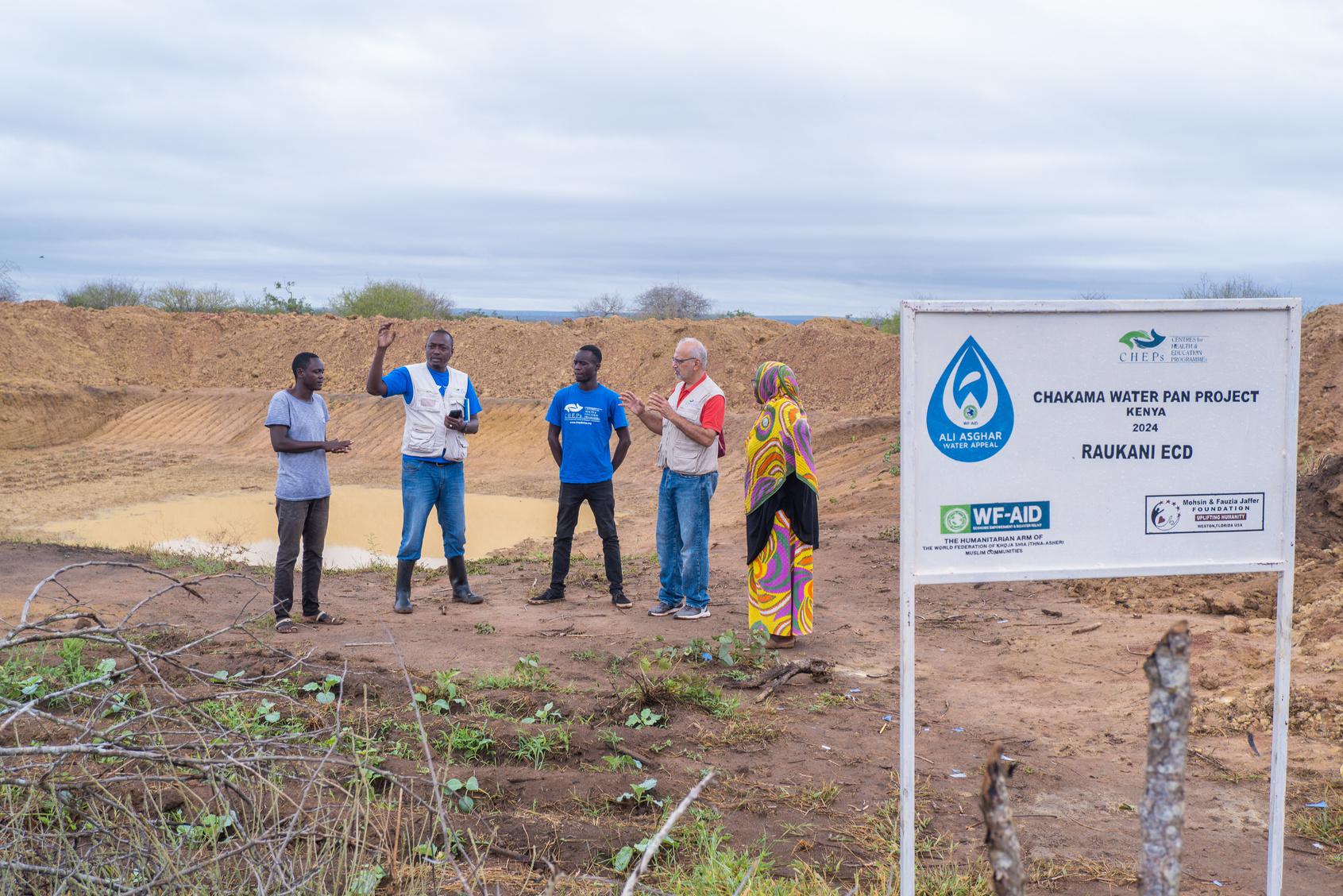
On behalf of WF-AID we thank you for generous contribution of USD 35,000 towards the construction of 10 water pans in the chakama region. Your donation has benefitted the lives of over 4,000 people.
These water pans will be a means to clean and safe water consumption and utilization for the residents of Chakama.
Rejoice in the good you have helped contribute to, but your reward lies with Allah. May he continue to shower his blessings on you and allow us to keep making impactful changes to the people who need it the most.
We are grateful to Rise Against Hunger for this appreciation. It is an honor to support their mission of ending hunger, and this recognition inspires me to continue contributing to initiatives that create meaningful and lasting impact.
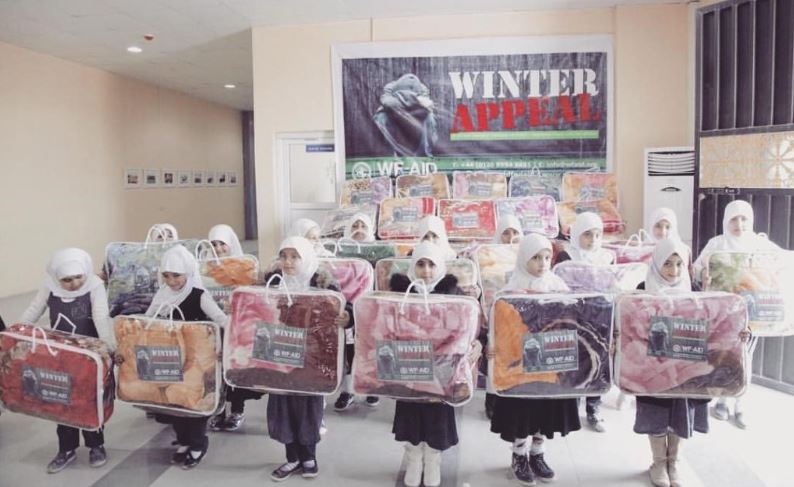
As the temperatures plummet this winter, hundreds of thousands of families face a daily battle to stay alive without the heating, food, and clothing they desperately need. Winter generally brings higher expenses, such as heating bills and warm clothes, but for families who already struggle throughout the year, they can’t afford the higher bills. They risk illnesses, and potentially, death. Refugees, who have no option but to live in make-shift shelters, exposed to the elements, are left to worry if their children will die from freezing or starving to death.
WF-AID are working in Afghanistan, Iraq, Yemen, Lebanon, Bangladesh, India, Pakistan, and the United Kingdom to distribute winter essentials to help them through these bitter months.
With respect to Pakistan, we are embarking on a project to distribute winter essentials to needy individuals and families across northern areas where the winter is particularly severe. Our ground partners are working in Skardu, Gilgit, Astore, Parachinar, Mianwali & D.I.Khan, giving help to those living in poorly made settlements. With no defence against the cold, winter conditions, the reality is that these vulnerable people could die as they can be trapped from the poor infrastructure caused by adverse weather. They suffer from a restriction on income as the conditions cause a standstill in their daily lives, leading to a heightened vulnerability.
To help them during these harsh winter months, we are providing widows, orphans and the general needy with thick quilts, blankets, and shawls. This would be of great support for their physical and mental conditions, being able to go about their normal activities with some warmth.
Locations
The aforementioned locations where WF-AID are targeting the project are all either overwhelmingly Shia or have a significant minority of Shia population, most of whom have suffered persecution or are currently in a destitute condition.
Parachinar
This is a town in the province of Khyber Paktunkhwa and is the capital of Kurrum District. The town is connected to Afghanistan by the Peiwar Pass, a strategic valley located 20km west of Parachinar, where heavy snowfall closes the region for up to five months per year. The town has been frequently hit by terrorist attacks against the Shia population, with over 500 people being killed since 2007. This has left numerous widows and orphans without any support. Due to the geography being on a hilly area, Parachinar has extreme climates, with harsh winters and hot summers.
Gilgit Baltistan
This is the northernmost territory administered by Pakistan part of the greater Kashmir region on the China and Afghanistan border, where the Hindu Kush mountains and the K2 peak are. The towns of Skardu, Gilgit and Astore are all part of this region where the ground agency is targeting the relief efforts. These areas suffer from extremely cold temperatures in the winter, where it often remains cold during the nights even in summer. Snow is common for four months.
District Mianwali
Located in Punjab Province, this hilly area suffers from temperatures extremes – with long, hot summers and cold, dry winters. It is a remote one of the poorest districts in Punjab. Most of the Shia population are settled near the River Indus, where they suffer from loss of property and life each time the flood banks break.
Project Specific
WF-AID would like to request the support of The Mohsin & Fauzia Jaffer Foundation, USA, to distribute warm shawls and material for shalwar kameez to the needy beneficiaries in the aforementioned locations.
These will be made out of warm woollen material to keep the beneficiaries warm from their heads up to their waist. The warm dress and shawl can be used continuously throughout winter for 2-3 years, improving the sustainability of the relief initiative.
Beneficiary Stories
The following are real-life beneficiary stories from WF-AID’s Winter Appeal in Pakistan last year. Name changed to protect identity.
Zeeshan Haider, 6th class at a school in Mari Indus, is an orphan. His father died 2 years ago. His siblings are 6 sisters and 2 brothers, who are being brought up by their relatives. The extended family are so poor they are unable to buy Zeeshan and his siblings proper clothing. He was without adequate clothing during the winter months at school. WF-AID provided a sweater to him and his siblings and protected him from the bitter cold.
Muhammad Ramzan, of D.I. Khan, was initially a resident of District Tannk, KPK. He was a labourer to earn resources for his family as a father of 7 children. After the worst of the sectarian conflict and the targeting of Shia Muslims in the region, he and his family migrated to Jabbar Wala to save their own lives and he worked as a labourer cultivating the land of villages. This is one of the most demanding and lowest paying work in rural Pakistan. When the distribution team providing him and his family with warm winter clothing, he was weeping and his hands were in the air with countless prayers for those who supported his family.
Budget Breakdown
The cost of these warm shawls and material is approximately USD $16 for each piece An ideal quantity for the initiative would be 1,000 units in total. Therefore, the total request is for USD $16,000 along with the WF-AID project implementation and operational amount of 5% ($800).
Item Description
Quantity
Total (in USD)
Woollen Shawls & Woollen Material (for Shalwar Kameez)
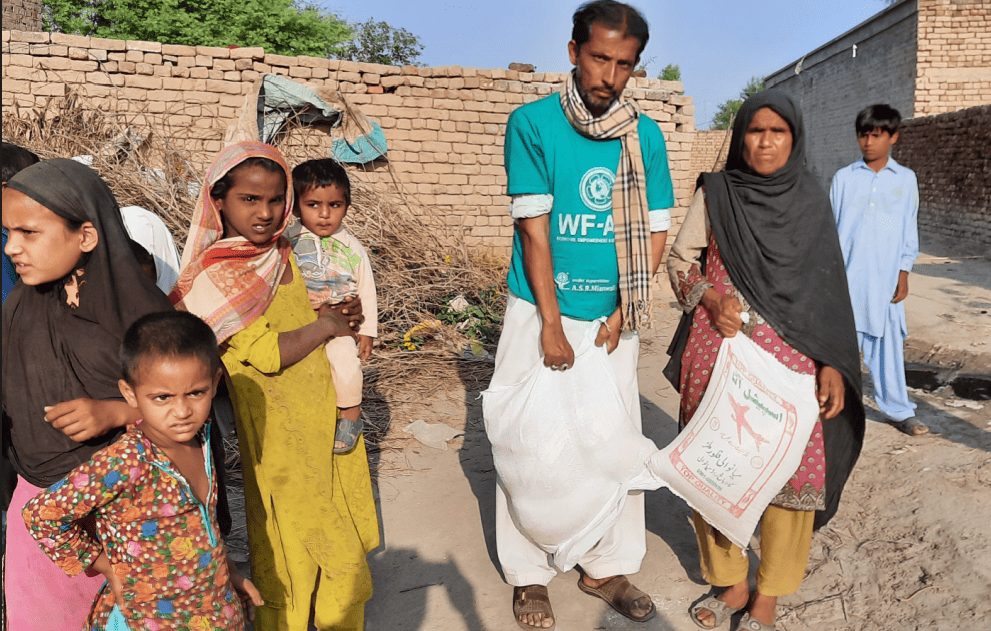
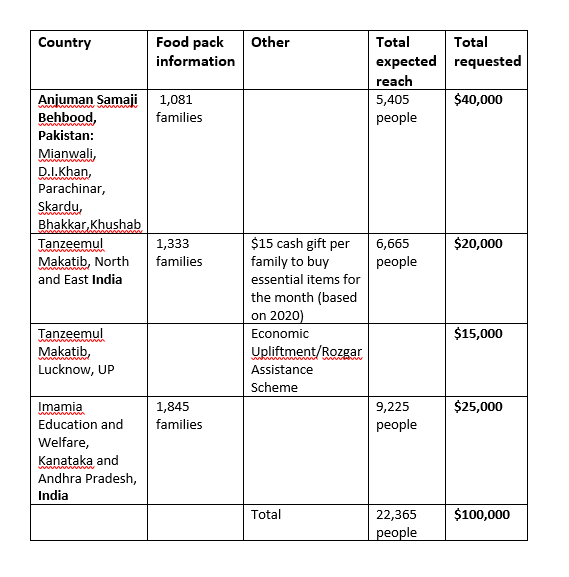
WF-AID’s Ramadan Relief appeal works to help some of the families most in need around the world during the Holy month of Ramadan. We distribute food aid in several countries around the world, including Kenya, India, Pakistan, and Yemen.
Food packs give refugees and families a rare opportunity to receive essential nutritional aid, which can sometimes be the difference between life and death. With the coronavirus pandemic sweeping the world, the need for food this year was higher than ever. Food markets closed, prices increased, and people were unable to work. Families who rely on community iftars didn’t have that option due to lockdown.
We worked with our partners to ensure each distribution was done safely, with team members wearing full PPE and marking 2m spaces on the ground for the beneficiaries to stand. Each food pack we distributed contained locally sourced items, so your valuable donations not only helped those in immediate need but supported the local economy. As with every year, we made sure that each individual pack was filled with food that is tailored to the tastes and flavours of local diets. Last year, we included hand soaps and cleaning and hygiene products to help people during this pandemic.
Purpose
The purpose of the aid is to provide families in need with food and cash gifts to ensure they have meals to eat during the Holy month of Ramadan. It also helps to reduce the burden on families in this current climate where COVID-19 has meant millions of people around the world are without employment, therefore making it even harder to put food on the table. It furthermore works as an act of tableegh as it encourages families to focus on their fasting and ibadaat during this Holy month without the worry of how they will eat, therefore allowing communities to establish fasting and prayer as commanded by Allah SWT and the Ahlubayt (Alayhim us salam).
Who Will Benefit
The project will benefit needy children, adults and elderly across Pakistan, India, and Tanzania.
Anjuman Samaji Behbood
The charity started its activities with a profile of general welfare activities and have now branched out to several forms of charitable work such as installing WASH facilities, eye clinics, winter distributions, micro finance projects and of course Ramadan distributions across several deprived areas such as Mianwali, Skardu and Parachinar.
Due to inflation, prices are increasing daily in Punjab and Pakistan as a whole and this is resulting in the poor becoming poorer. Unemployment is very high and in the villages there are many young people who do not have work and are therefore unable to support their families, more so now because of COVID-19.
Bilal Muslim Mission – Tanzania
Temeke District is one of the three districts of Dar es Salaam and has a historic significance for the Khoja Community as it is where the birth of Bilal Muslim Mission was envisioned by AFED in the 60’s.
As BMMT have been involved in community activities for many years their ground research has also established areas where the need differs to others. For example, the number of people per family differs from coastal and non coastal areas due to factors such as polygamy being more common and a high birth rate.
In coastal areas the number of people in one family may be up to 9 whereas non coastal maybe a maximum of 7. This then means the food ration quantity is amended to cover a larger family for one month.
Tanzeemul Makatib
Tanzeemul Makatib was established in 1968 with the aim of ‘upliftment & development’ of the depressed class within the society, especially the Indian Shia Muslim community by propagating education, guidance, awareness and training. Since its establishment, Tanzeemul Makatib has been continuously dedicated towards providing education, raising social awareness, offering social counselling, training, and publishing & distributing text books & other teaching aids etc. contents etc. to the community.
In addition to this, Tanzeemul Makatib distribute food packs and/or cash gifts to those they have identified as in desperate need for the Holy month and have done so for many years.
Imamia Education and Welfare
Established in 1989, Imamia Education and Welfare Trust has been dedicated to socio, economic, education and upliftment of the community. This has mainly been through religious and political classes and events but also providing medical aid and scholarships. They have also been involved in the distribution of food during the month of Ramadan to several areas across Kanataka and Andhra Pradesh for many years.
Details of Provision
The families are provided with a variety of essentials to provide them with sehri and iftar over the Holy month and in some places, communal iftars will take place. Each food pack includes staple and nutritious items such as rice, flour, lentils, chick peas, dates, sugar and tea.